
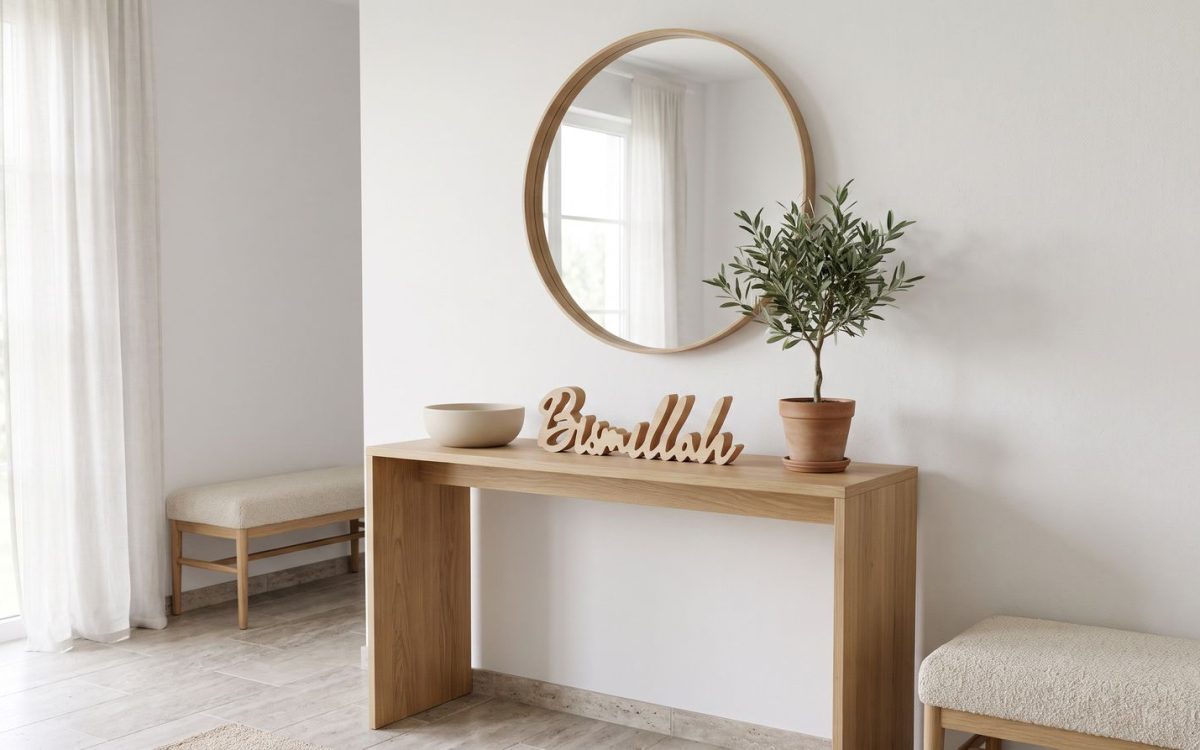
For many of us, the day begins with a «Bismillah» half-awake and ends with an «Alhamdulillah» on the couch. We don’t even notice them anymore. These Arabic words cross our sentences in French, Dutch or German at work and on the phone with our families back home. They have become our intimate language.
Here are the twelve most common ones: what they exactly mean when they are said, where they come from in the Quran and the Sunna, and how some end up finding a place on our walls.
Why these words matter so much
In Islam, remembering God is not limited to the five prayers. The dhikr (Mentioned, The reminder) slips into ordinary gestures: eating, going out, receiving good news, sneezing. Each little phrase connects a banal moment to something greater.
"It is by the remembrance of Allah that the hearts are at peace."
« Is it not by the mention of Allah that hearts are calmed?»
Quran, Surah Ar-Ra’d (13), verse 28 · translation of the meaning
For families from the diaspora, there is one more reason. Our children grow up between two languages and these expressions are often the first Arabic words they remember. Even before they know how to read, they know that they say Bismillah before eating. It is a subtle transmission, which passes through the ear and through habit.
The 12 Muslim words of everyday life, at a glance
| Mot | Arabic | Sense | When you say it |
|---|---|---|---|
| Bismillah | In the name of Allah | In the name of God | Before you start: eating, going out, driving, working |
| Alhamdulillah | Thank God | Praise to God | After a meal, good news, a sneeze, or to say «it's okay» |
| Salam / As-salamu alaykum | Peace be upon you | Peace be upon you | To greet when arriving or entering your home |
| InshaAllah | God willing | If God wills it | When we talk about a project or the future |
| MachaAllah | By Allah, as it should be. | What God wanted | To admire something beautiful without being jealous |
| SubhanAllah | Praise be to Allah | Glory to God | To the astonishment, the beauty of nature |
| Allahu akbar | Allahu Akbar | God is greater | In prayer, and in joy or emotion |
| Astaghfirullah | I beg Allah's forgiveness | I ask God's forgiveness | After a mistake, one too many words |
| BarakAllahu got | God bless you | May God bless you | To thank or congratulate |
| JazakAllahu khayran | May Allah reward you well | May God reward you with good | To thank someone for a service |
| Sabr | Patience | Patience, endurance | To encourage in an event |
| Mubarak | Mubarak | Blessed | In the wishes: Ramadan Mubarak, Eid Mubarak |
Bismillah: in the name of God, to start well
Bismillah (In the name of Allah, pronounced bis-mil-lah) is the short form of «Bismillahi r-Rahmani r-Rahim», «in the name of God, the All-Merciful, the Most Merciful». It is the phrase that opens almost all the surahs of the Quran. It is said before eating, drinking, embarking on a journey, entering one's home, or undertaking a difficult task.
The Prophet ﷺ taught it simply to a child, Umar ibn Abi Salama, who ate by dipping everything in his plate:
«My son, mention the name of Allah, eat from your right hand and eat from what is in front of you,» he said.»
Hadith reported by al-Bukhari (5376) and Muslim (2022)
There is also a hadith that speaks directly about the house: when one mentions God when entering the house and at mealtime, the devil says that he will find neither shelter nor food (reported by Muslim, 2018). That is why the word Bismillah has such a meaning near the entrance door or in the kitchen.
Alhamdulillah: gratitude in one word
Alhamdulillah (Thank God) means «praise belongs to God.» It is the first verse of the Fatiha after the basmala: «Al-hamdu lillahi rabbil-‘alamin,» «praise be to Allah, Lord of the universe» (Surah 1, verse 2).
In everyday life, this is the answer to «How are you?» for a good portion of the community, whether the day is good or not. It is also said after eating and after a sneeze, as the Prophet ﷺ taught (al-Bukhari, 6224). The one who hears it replies «Yarhamuk Allah,» «May God have mercy on you.».
«Purification is half of faith, and al-hamdu lillah balances the scales.»
Hadith reported by Muslim (223)
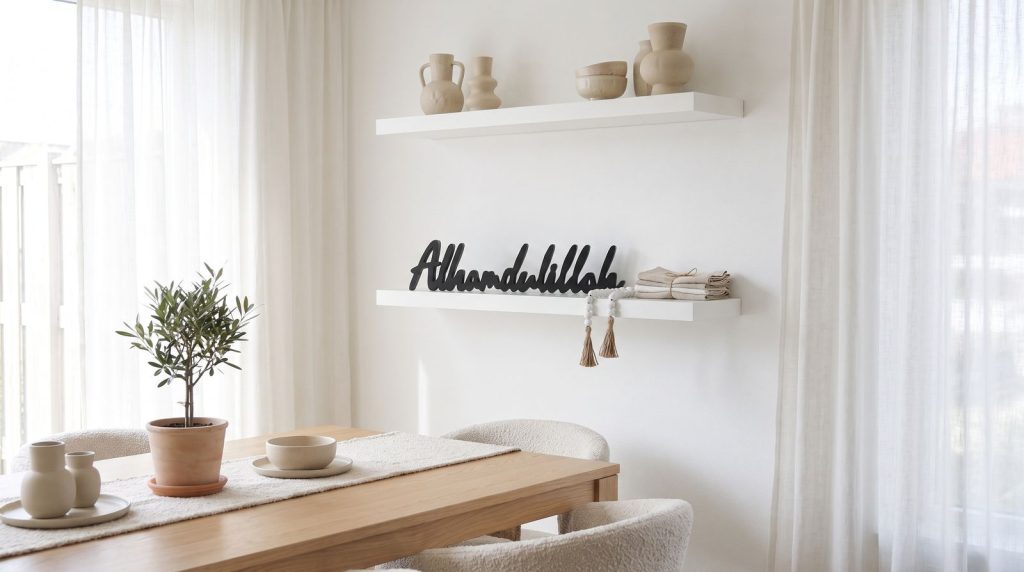
Having that word in sight in the living room or dining room is a little reminder of the days when we complain about little things. We talk about it in more detail in our article on the sword and gratitude.
Salam: the peace we wish each other on arrival
Salam (Hello) means «peace». The full greeting is «As-salamu alaykum», «may peace be upon you», to which one replies «Wa alaykum as-salam». As-Salam is also one of the names of God (Sura Al-Hashr, 59, verse 23).
«You will not enter Paradise until you believe, and you will not believe until you love yourself. Do you want me to tell you something that, if you do it, will make you love yourself? Spread the salam between you.»
Hadith reported by Muslim (54)
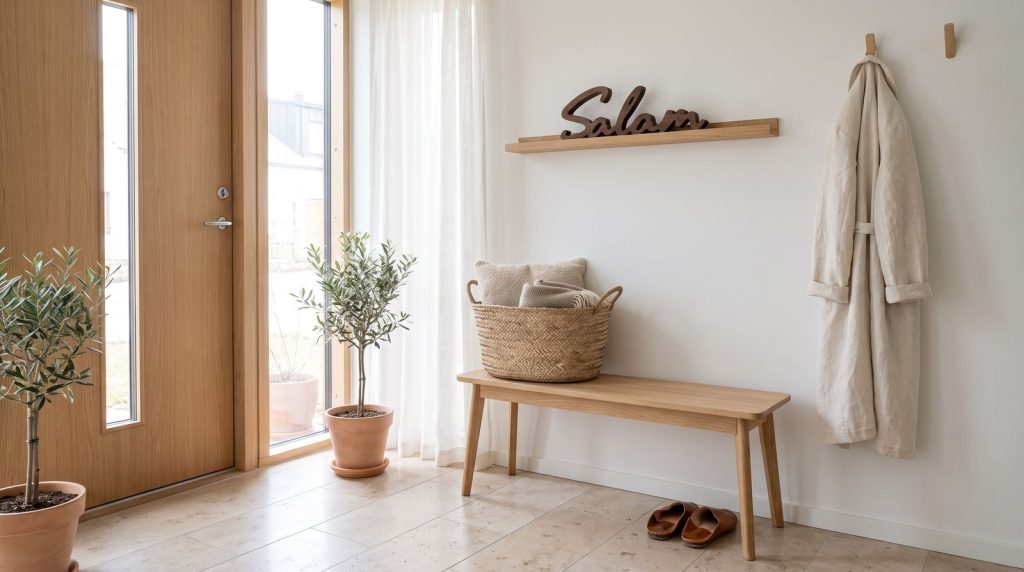
The Quran even calls for greeting when entering a house, including one’s own: «When you enter houses, greet each other with the greetings of Allah, blessed and pleasant» (Surah An-Nur, 24, verse 61). A Salam at the entrance is therefore much more than just a welcome decoration: it is the first word the guest receives.
InchaAllah, MachaAllah, SubhanAllah: three expressions not to confuse
InshaAllah (God willing), «if God wills it», accompanies everything concerning the future. The Quran expresses it directly: «And never say about a thing: »I will surely do it tomorrow,« without adding: »if Allah wills.'" (Surah Al-Kahf, 18, verses 23 and 24). Yes, it is sometimes used to say politely "we will see." But at its core, it is a sign of humility: we make plans; we don't control everything.
MachaAllah (By Allah, as it should be.), «what God has willed», one says in front of something beautiful: a baby, a house, success. The formula comes from the same sura: «Ma sha Allah, the quwwata illa billah», «such is the will of God; there is no strength except through God» (18, verse 39). It is a way of admiring by giving the credit to God, without desire.
SubhanAllah (Praise be to Allah), «Glory to God», expresses amazement or surprise. With Alhamdulillah and Allahu akbar, this is the formula that is repeated 33 times after prayer, on the fingers or with a tasbih (we discuss this in our article). on the salad plate at home).
«Two light words about the tongue, heavy in the balance and loved by the All-Merciful: Subhan Allahi wa bihamdihi, Subhan Allahil-‘Azim.»
Hadith reported by al-Bukhari (6406) and Muslim (2694)
Allahu akbar, Astaghfirullah: the big and small moments
Allahu akbar (Allahu Akbar) means «God is greater». It is the first word of the prayer, the one of the call to prayer, and the one that we spontaneously let go when emotion overflows: a birth, a goal at the last minute, a reunion at the airport.
Astaghfirullah (I beg Allah's forgiveness), «I ask God’s forgiveness,» serves as a reminder after a lapse, a word too many, a thought that one regrets. The Prophet ﷺ himself said to ask God’s forgiveness more than seventy times a day (al-Bukhari, 6307). In the parents« mouths, it is also the word that means »I don’t believe my ears.”.
BarakAllahu fik and JazakAllahu khayran: other ways to say thank you
Among Muslims, «thank you» often doubles as a prayer. BarakAllahu got (God bless you), «May God bless you», thanks and congratulates at the same time. JazakAllahu khayran (May Allah reward you well), «May God reward you with good», is considered the best way to thank:
«He who has been shown kindness and who says to his benefactor: jazak Allahu khayran, thanked him in the best way.»
Hadith reported by at-Tirmidhi (2035)
Sabr and Mubarak: patience and blessed days
Sabr (Patience) is patience, but an active kind of patience: holding on, remaining dignified, continuing to do good when it is hard. «Allah is with those who are patient» (Sura Al-Baqara, 2, verse 153). He has been dedicated to it. a complete article.
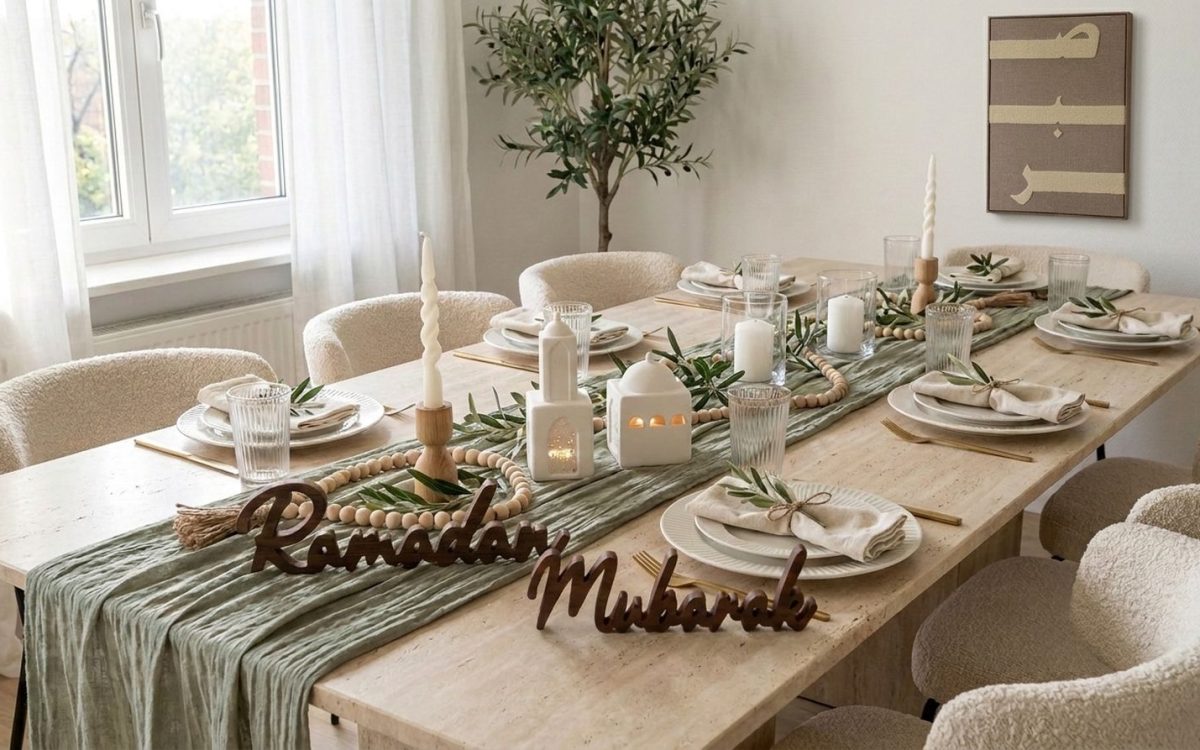
Mubarak (Mubarak), «blessed», is the word of wish: Ramadan Mubarak, Eid Mubarak, Jumu’a Mubaraka on Friday. It returns every year to our festive tables.
How to display these words at home, with respect and restraint
Putting one of these words on the wall is not «oriental» decor. It’s choosing a reminder that we’ll see dozens of times a day. A few principles that we apply at our house:
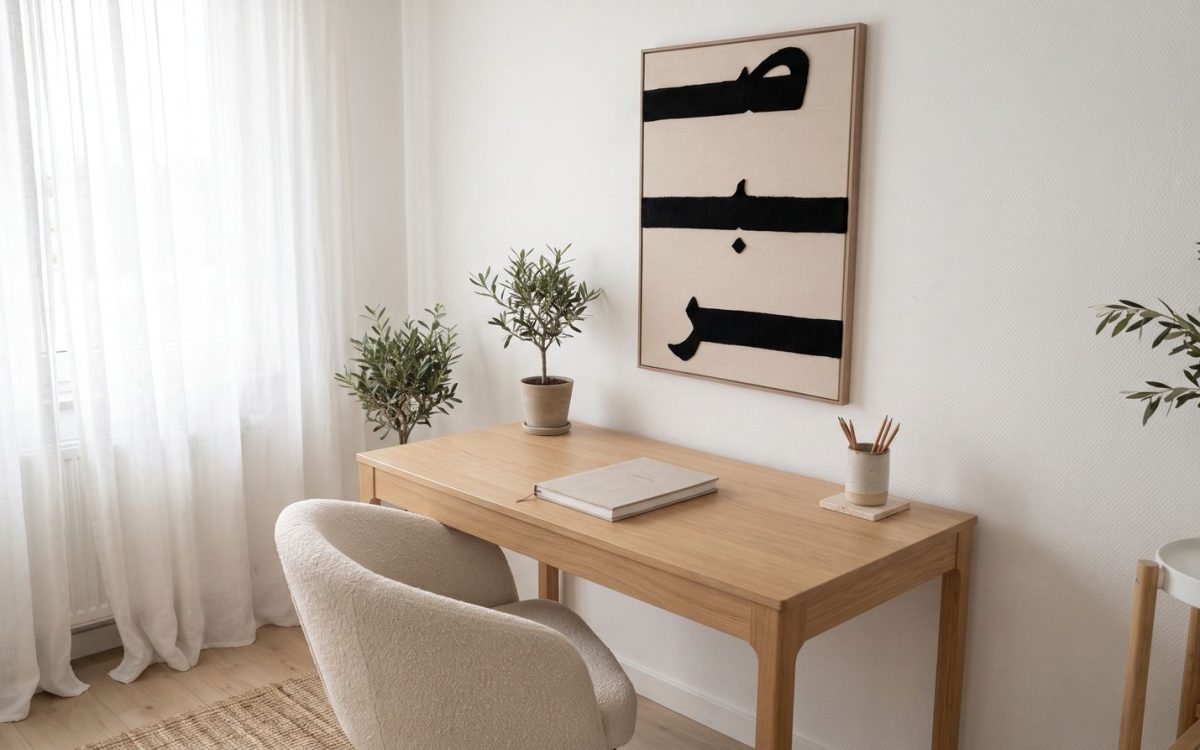
- One word per piece, not ten. Bismillah in the entrance or the kitchen, Salam near the door, Alhamdulillah in the dining room, Sabr in an office or a bedroom. A well-placed single word speaks louder than a collection of words.
- The right place. Words that contain the name of God should be at eye level or higher; never in the bathroom or at ground level. This is a matter of respect that everyone agrees on.
- Materials that last. Wood ages beautifully, it gets patinated and doesn't crack like plastic. A word on raw or tinted wood blends well with a Scandinavian interior, just like a Moroccan living room.
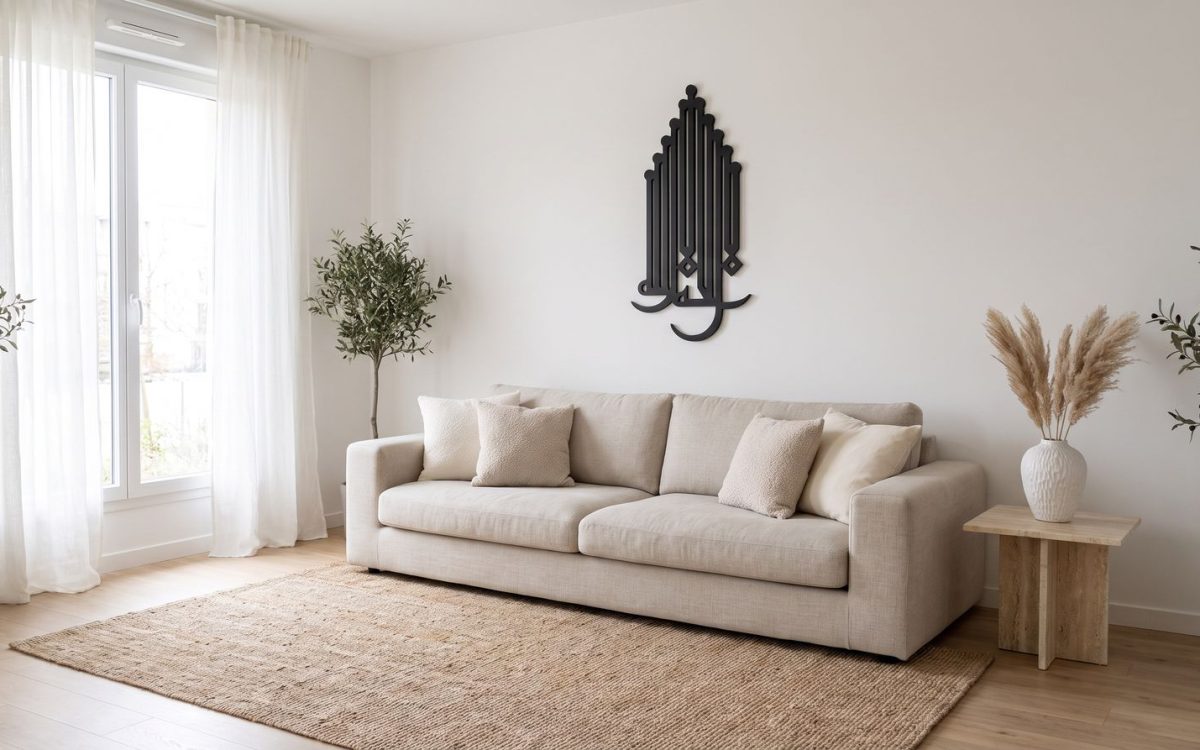
- Calm colors. White on a light wall for a discreet effect, black for contrast, natural wood for warmth.
To go deeper into the overall atmosphere, read our article on modern and purist Muslim decor.
And for the children?
The written words become landmarks. A child who sees Bismillah on the kitchen wall eventually says it out loud before eating. You can make it a game: each word has its own time, and it’s he who reminds the parents when they forget. This is often how everyday Arabic is passed on here, away from grandparents.
Are you looking for a gift around these words? Our selection of Muslim gifts that make sense That's exactly where it starts.
 Français
 Deutsch
 Nederlands
 English