
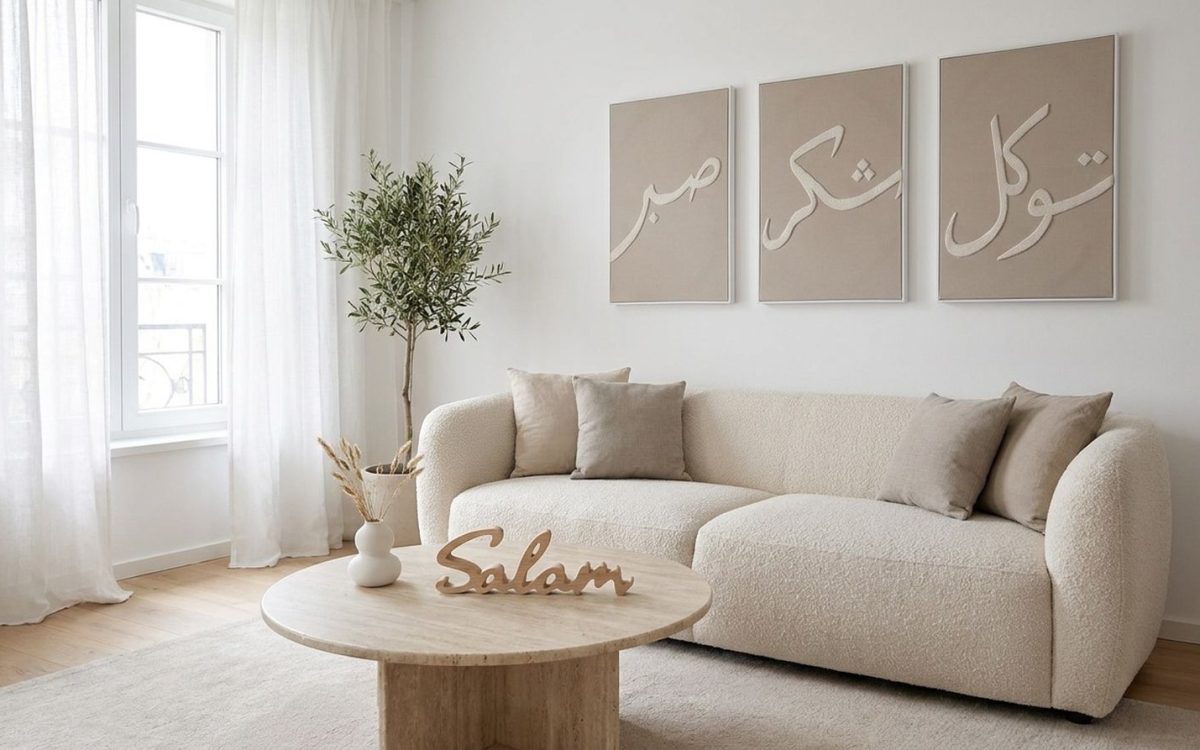
Type «Muslim decor» into a shopping site and you’ll quickly see the problem: vinyl stickers, gold-plated plexiglass, mirrored panels with sequins, printed fabrics in series production. There’s demand, so there’s supply. But many of us are looking for something else: a home where you feel you’re among Muslims, without it looking like a souk.
Good news: it works in a few simple steps. Here are nine ideas that we apply in our studio and that our clients are seeing work in their homes, from the studio in the city to the family home.
What is modern Muslim decor?
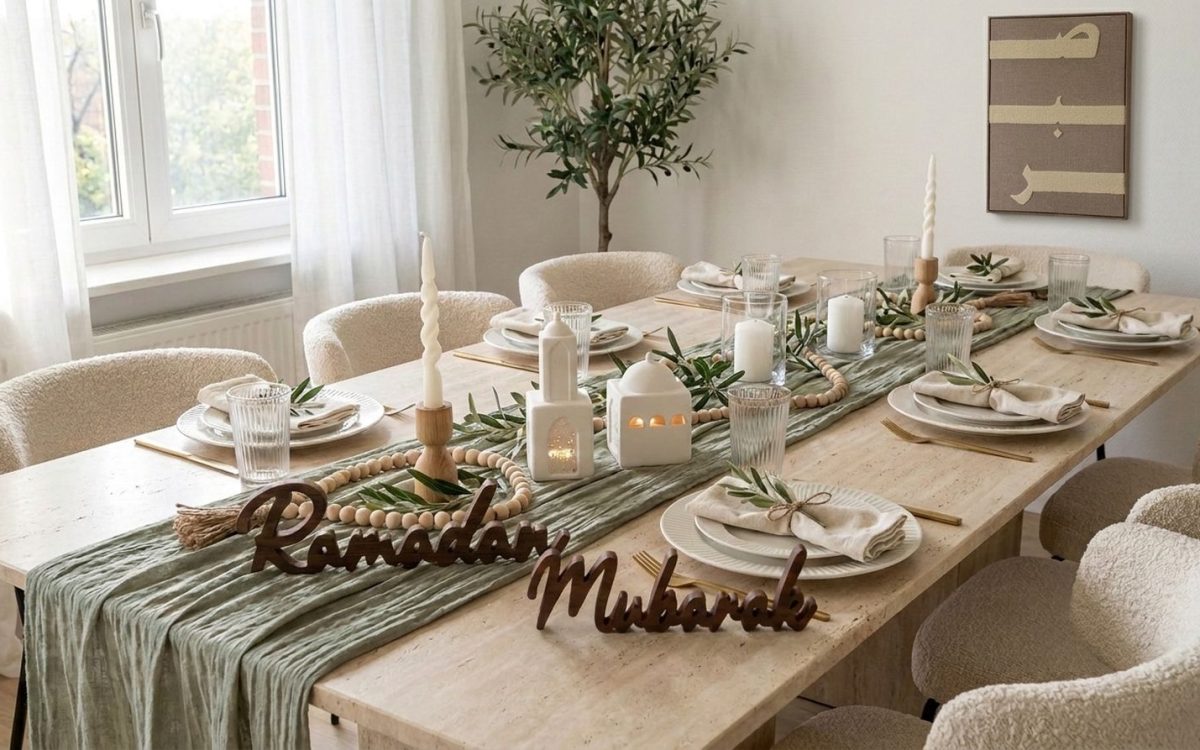
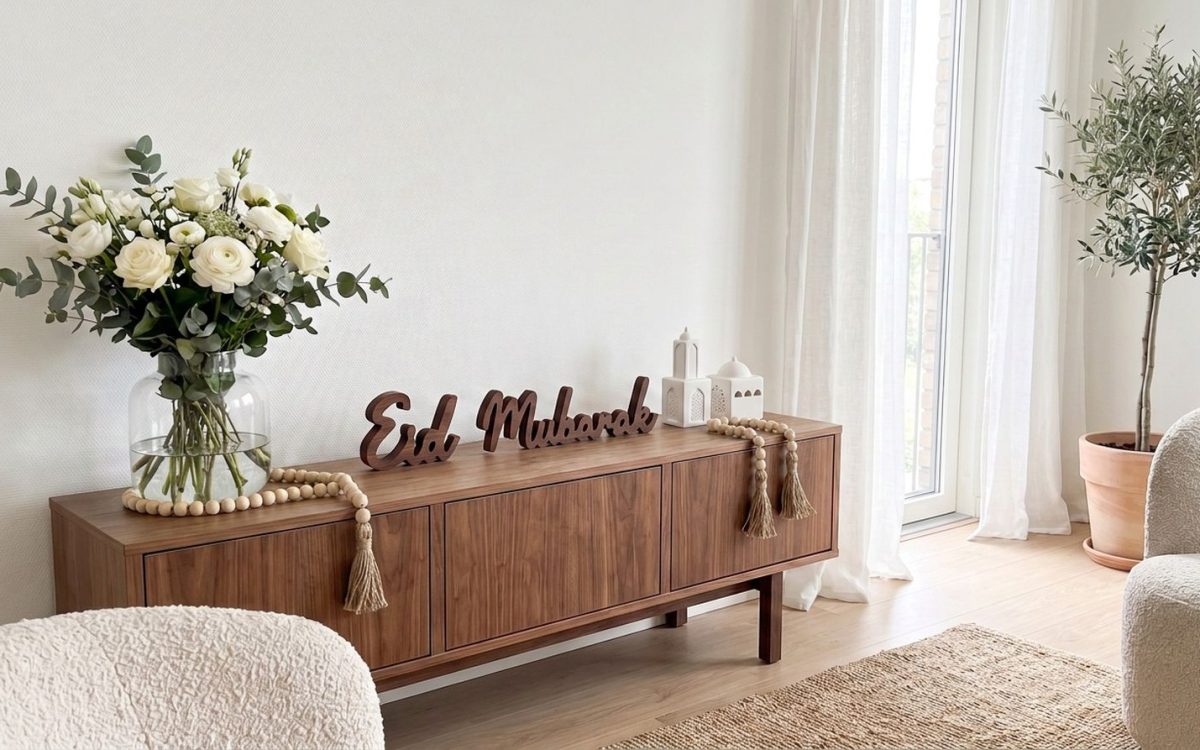
Modern Muslim decor is a contemporary interior where faith is present through a few selected elements: an Arabic word, calligraphy, a place to pray or read the Quran, a fragrance. No theme, no over-the-top details. The rest of the house remains simple, with natural materials and calming colors.
This austerity is not just a Scandinavian trend; it also reflects something very ancient in our culture.
«Allah is beautiful and He loves beauty.»
Hadith reported by Muslim (91)
The same Prophet ﷺ lived in a very modest house: Umar ibn al-Khattab recounts having found him lying on a mat that had marked his side, in a room that was almost empty (reported by al-Bukhari and Muslim). Beauty, yes. Accumulation, no. That is exactly the balance we are looking for.
1. One word per room, not one word per wall
The first mistake is to use it everywhere. A Bismillah in the entrance, an Alhamdulillah in the dining room, a Sabr in the office: each word has its place and its time. We have detailed the meaning of each in our guide daily Muslim words.
2. Wood rather than plastic
Plastic and acrylic shine on the first day, then they turn yellow, scratch, and pick up dust in every corner. Wood does the opposite: it wears down, repairs itself, and ages with the house. It is also more pleasant to touch and look at.
There is a deeper dimension. The Quran reminds us that we are responsible for the earth that has been entrusted to us:
Corruption has appeared in the land and the sea because of what the hands of people have earned.
«Corruption has appeared on earth and in the sea because of what people have accomplished with their own hands.»
The Quran, Surah Ar-Rum (30), verse 41 · translation of the meaning
Choosing objects that last, made from natural materials, is a small way to be Khalifa (Khalifa), a guardian rather than a consumer. «This lowly world is sweet and green, and Allah has made you its successors to see how you act» (hadith reported by Muslim, 2742).
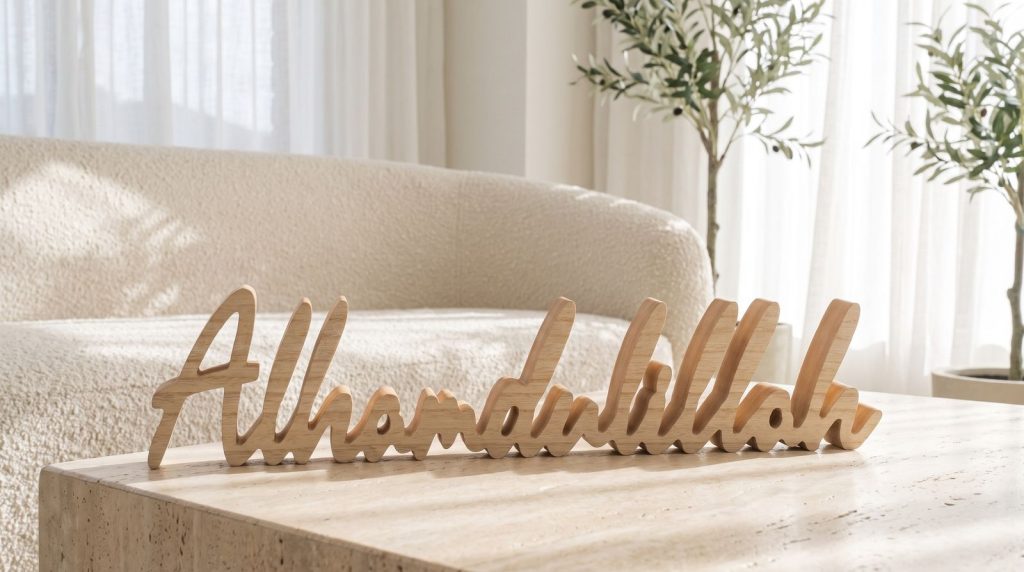
3. An earthy palette: sand, wood, black, off-white
Forget the systematic use of gold and emerald green. A palette of sand, terracotta, light wood, with a touch of black, highlights the calligraphy without being too ostentatious. It is also the palette of the mud-brick houses of southern Morocco and the ancient mosques: nothing is more timeless.
Simple tip: choose the color of the word based on the wall. Natural wood or black on a white wall, white on a dark wall or in polished concrete.
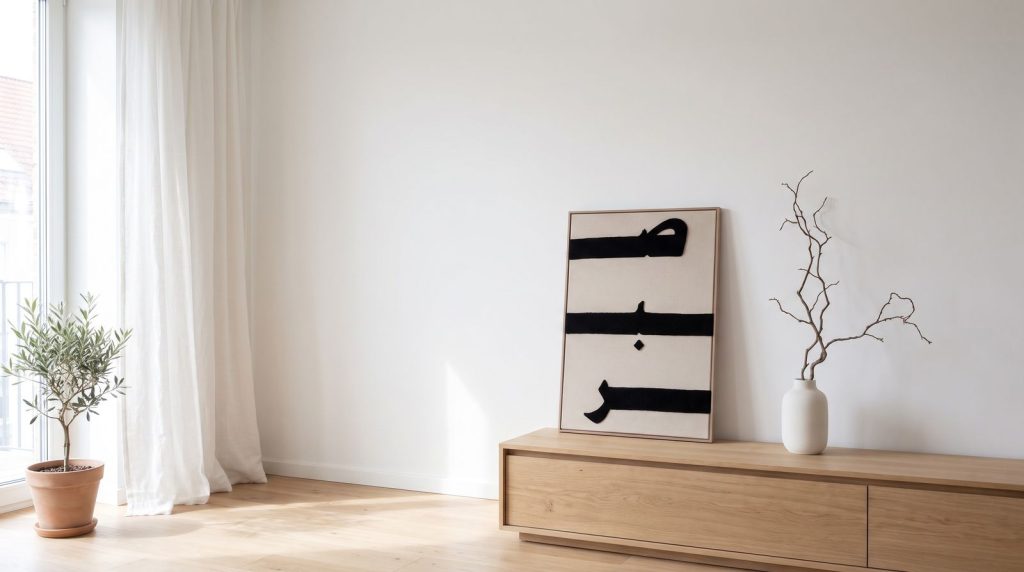
4. One strong piece: calligraphy
In a living room, a large calligraphy is enough to set the tone. The shahada, «La ilaha illa Allah», is the strongest of all, and for good reason: it is the testimony of faith. Hung above a sofa or in front of the entrance, it becomes the focal point of the room. We explain how to choose it and where to hang it in our article on the shahada on the wall.
5. Soft light in the evening
The white lamps kill the atmosphere. In the evening, a low lamp and a photophore are enough. This is especially true during Ramadan, when the evenings stretch out after the iftar and tarawih prayer. The light from a candle through a photophore immediately creates that calm that we associate with the nights of Ramadan in our parents’ homes.
6. A real place for the Quran
In many homes, the Quran is stored high up, packed away, and taken out for Ramadan. Giving it a visible place, on a Quran stand (rahla, A journey) Opened in a quiet corner, it changes the way we relate to it. We can see it, so we open it. The support also prevents it from being placed on the floor or on the knees.
7. A house that smells good
Perfume is part of Muslim culture far more than just decoration in the strict sense. The Prophet ﷺ loved perfume, and perfuming the house on Friday or upon the arrival of guests is a tradition in many families, from Morocco to the Gulf. A discreet diffuser in the entrance does more for the welcome than any object could.
8. Natural textiles
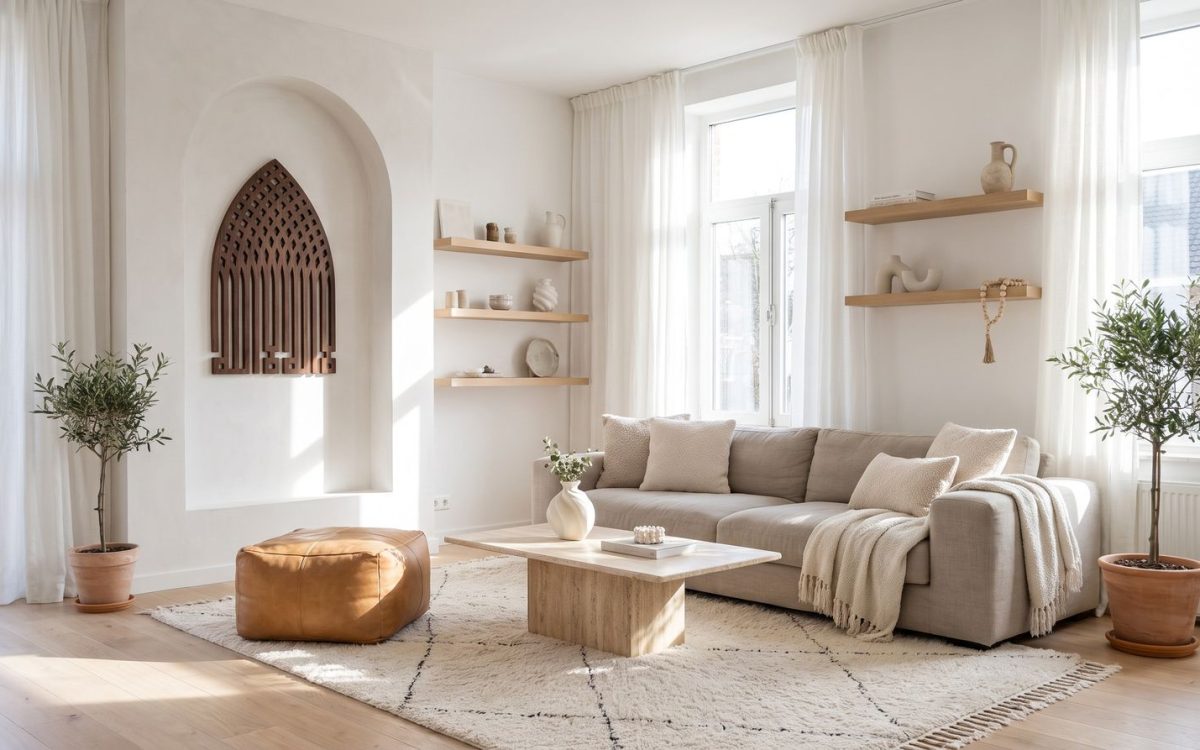
Lin, thick cotton, wool, kilim or Berber carpet: natural textiles warm up a minimalist interior without overwhelming it. A wool plaid on the sofa, a hand-woven rug under the coffee table, linen curtains that let the light through. Avoid glossy polyester; it immediately ruins the effect.
9. Leave room to breathe
The hardest part is not adding anything. A blank wall around calligraphy makes it more valuable than three tightly packed frames. You keep less, but better, and you keep what makes sense.
«Be in this world as a stranger or a traveler passing through.»
Hadith reported by al-Bukhari (6416)
This hadith does not require living in an empty house. It simply reminds us not to get attached to things. A clean interior is a bit like that: you are comfortable there, without being a slave to it.
Common mistakes
- Buy everything at once. A house is built over time. Start with a word or a calligraphy, see how you live with it, then complete it.
- Mixing too many styles. Moroccan, Ottoman, Scandinavian and gold in the same room is too much. Choose a base (often minimalist) and an accent.
- Placing the name of God anywhere. Not in the bathroom, not on the floor, not behind a door that you slam. That is the minimum of respect.
- Forget the function. A prayer corner must first be practical: well-lit, quiet, with the carpet within easy reach. We talk about it in our guide to the Salat district.
You grew up between two cultures and want to bring a bit of the countryside back into your home? Our article on Moroccan and Oriental decor in Europe takes the subject in that direction.
 Français
 Deutsch
 Nederlands
 English