
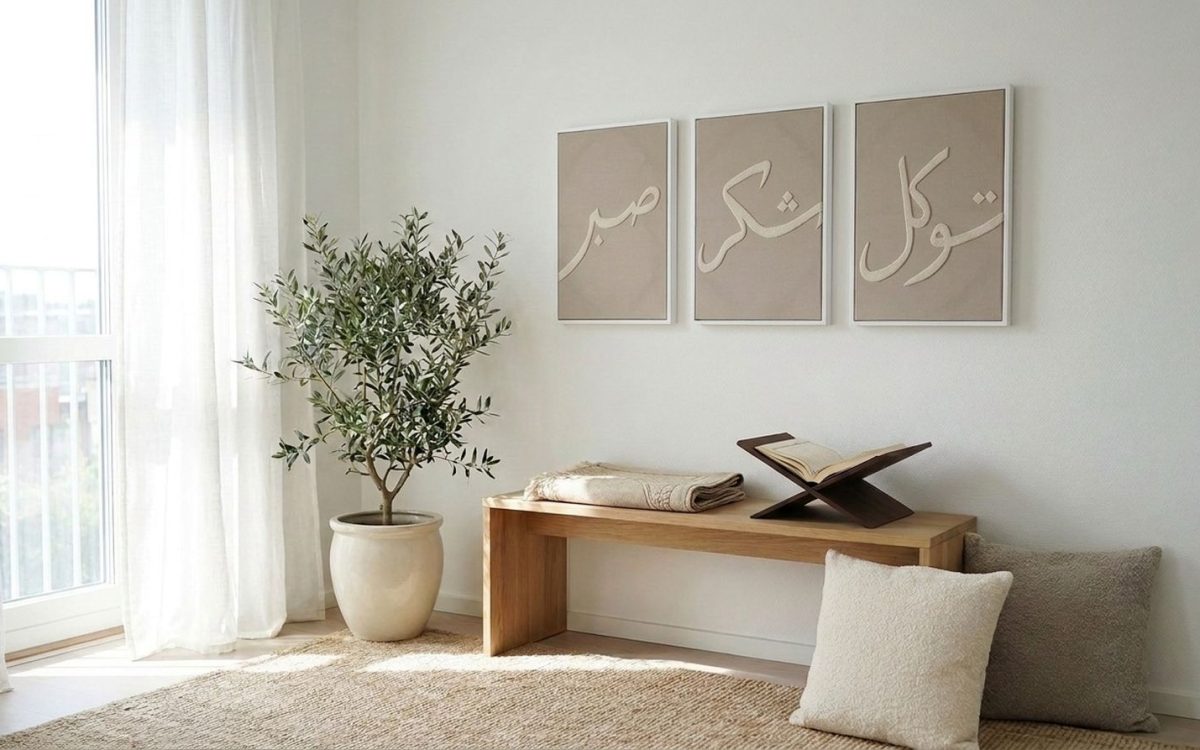
In many apartments, prayer takes place where there is room: between the sofa and the coffee table, at the end of the bed, in the hallway. The carpet is rolled up in a corner, the tasbih is lost in a drawer. It works, but you lose something. A real prayer corner, even if small, changes the way we pray: we return to it more easily, we stay longer there, the children come to it on their own.
Here’s how to arrange it: from choosing the location to tasbihs, to the new trend of wooden placemats.
Why have a prayer corner at home?
The salad (Prayer) structure the Muslim day, five times a day. Part of it is necessarily done at home, and the Prophet ﷺ kept it that way:
«Make a part of your prayers in your homes, and do not make them into tombs.»
Hadith reported by al-Bukhari (432) and Muslim (777)
A house where one prays is a living house. And a dedicated space makes prayer easier to keep, just as a desk makes teleworking easier.
And establish the prayer for My remembrance
«And perform the prayer to remember Me.»
Quran, Surah Ta-Ha (20), verse 14 · translation of the meaning
1. Choose the location
Three criteria are sufficient:
- The calm. Far from the TV, the passage to the kitchen, the toys.
- The cleanliness. Clean floors, a place where you don’t walk in shoes.
- The management. A wall oriented towards the qibla (Kiss), the direction of the Kaaba in Mecca. In France, Belgium and the Netherlands, it is roughly located in the southeast. Check it with a compass or a qibla app, then mark it once and for all.
One meter on two is enough for one person. To pray as a family, plan for a little more width.
2. Mark the qibla with a mihrab
In the mosques, the mihrab (Altar), the niche carved into the wall indicates the direction of prayer. At home, a calligraphy in the shape of a mihrab plays the same role: you immediately know where to place yourself, and the corner takes on a real identity.
One point of attention: prayer requires concentration. The Prophet ﷺ had asked Aisha to remove a patterned curtain placed in front of him, because the patterns distracted him during prayer (reported by al-Bukhari, 374). Therefore, this wall is kept simple: only one calligraphy, hung above the eye line rather than right above the eyes, no frames or other objects.
3. A beautiful rug, always ready
The prayer mat, sajjada (Carpet), is the heart of the room. Choose a thick one for knee comfort, in neutral colors, with natural fibers if possible (wool, cotton). And above all, keep it accessible: a carpet that has to be searched for at the bottom of a closet is a prayer that we avoid.
4. The trend for wooden prayer rug holders
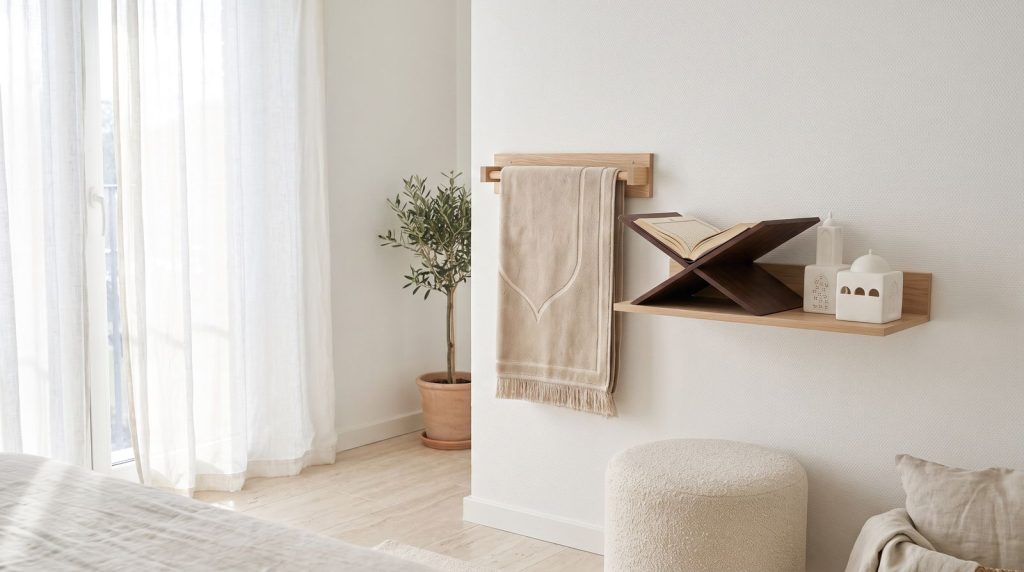
This is the object that has been appearing everywhere for some time now: the wall prayer mat made of wood. A bar or support attached to the wall, on which the carpet is folded after prayer. It solves three problems at once: the carpet no longer gets dragged across the floor, it remains clean, and it becomes a fully-fledged decorative element, like a plaid on a ladder.
Hanging beneath the mihrab calligraphy, it forms a coherent ensemble: the wall of the qibla becomes the prayer area, even when one is not praying. Choose it in solid wood, the same color as your other objects (natural, walnut, black), and provide for a solid attachment: a thick carpet weighs heavier than one might think.
5. The tasbih, a companion of dhikr
The tasbih or misbaha (Mosque) is the Muslim rosary, of 33 or 99 grains. It is used to count the dhikr, Especially after prayer:
«Whoever, after each prayer, says SubhanAllah thirty-three times, Alhamdulillah thirty-three times and Allahu akbar thirty-three times, which makes a total of ninety-nine, then completes the hundred with: La ilaha illa Allah, wahdahu la sharika lah, lahu l-mulk wa lahu l-hamd, wa huwa ‘ala kulli shay’in qadir, his mistakes are forgiven; would they be as numerous as the foam of the sea?»
Hadith reported by Muslim (597)
The Prophet ﷺ relied on his fingers and encouraged doing so: «Count them on your fingers, for they will be questioned and brought to speak» (reported by Abu Dawud, 1501, and at-Tirmidhi, 3583). Many scholars allow tasbih as a practical aid, and it is part of the daily routine of millions of Muslims. Made of olive wood, sandalwood or stone, it also has a beautiful touch. Provide it with a fixed place: a small hook, a saucer on the stool, or suspended from the tray.
6. The Quran at your fingertips
After prayer, this is the ideal time to read a few verses. A Quran rest (rahla, A journey) placed on a stool or a low shelf, with the Quran ready to be opened, invites one to do so. He also avoids placing the Book on the ground out of respect.
7. A light and a scent
For fajr in winter and late Isha, a soft light is preferable to a ceiling light: a photophore or a small lamp will suffice. Preparing for prayer also means dressing appropriately:
O children of Adam, take your adornment with you to every mosque.
«O children of Adam, in every place of worship, wear your adornment.»
Quran, Surah Al-A’raf (7), verse 31 · translation of the meaning
This verse first talks about clean and decent clothing. The perfume comes from the Sunna: the Prophet ﷺ loved perfume, and said that the freshness of his eyes was brought about by prayer (reported by an-Nasa’i, 3939). A discreet diffuser near the prayer area makes it a place where one wants to stop.
8. Storage: veil, qamis, children's prayer rugs
A wicker basket or a small low cabinet to store the prayer shawl, the qamis, and the children’s rugs. Everything is there, everything is ready. For the little ones, a mat of their size next to that of the parents is the best way to inspire them to imitate.
The ideal prayer corner, in short
| Element | Role | Our advice |
|---|---|---|
| Location | Calm and cleanliness | A wall oriented towards the qibla |
| Calligraphy on the mihrab | Mark the direction | Above the gaze, sober wall |
| Saddha (sajjada) | Comfort and cleanliness | Thick, natural fibers |
| Wooden tray | Organization and decoration | Solid wood, solid fixing |
| Tasbih | Counting the dhikr | A fixed place so as not to lose it |
| Repose-Coran | Reading after prayer | Open, at your fingertips |
| Light and perfume | Atmosphere and decor | Soft light, discreet fragrance |
To go further, our article on the shahada on the wall explains how to choose and hang a calligraphy, and our guide to everyday words returns to SubhanAllah, Alhamdulillah and Allahu akbar.
 Français
 Deutsch
 Nederlands
 English