
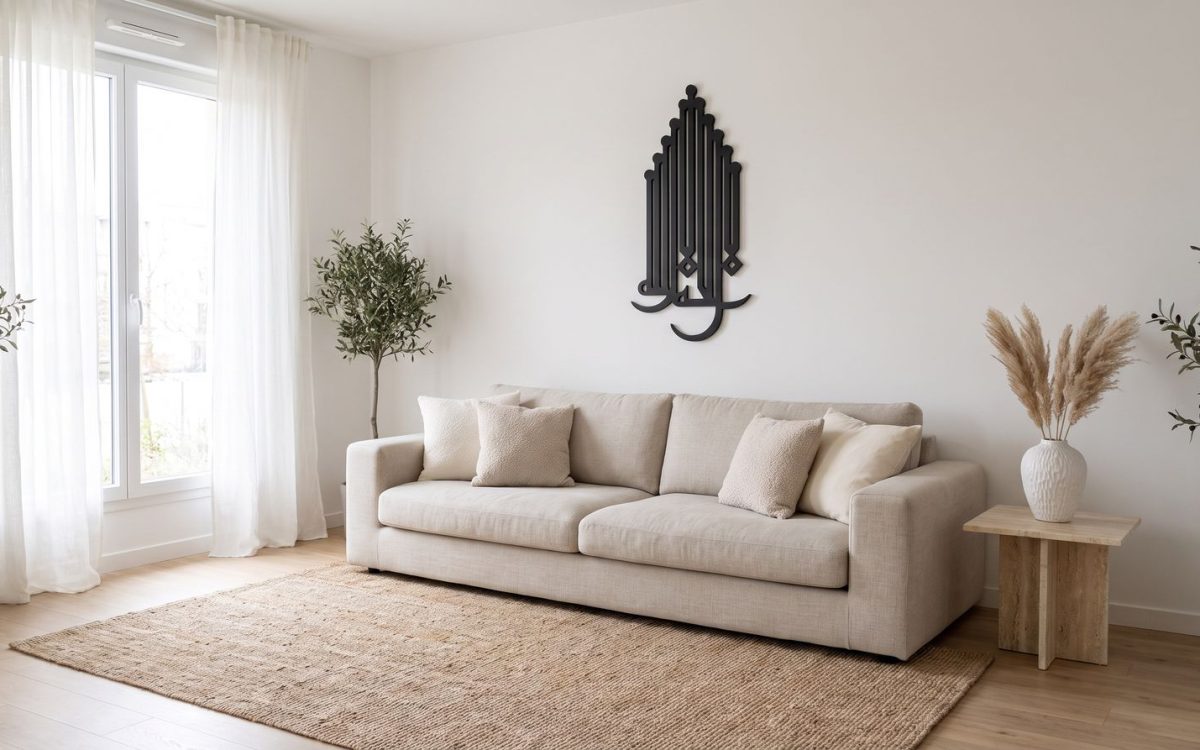
Of all the calligraphies that can be displayed at home, the shahada is the strongest. It’s not a pretty phrase; it’s the testimony of faith, the phrase that makes a person a Muslim. Hanging it on the wall is a choice that deserves some thought: what it means, where to place it, how to respect it.
What does the shahada mean?
The Shahada (Certificate, «The testimony» is the testimony of faith in Islam: «Ash-hadu an la ilaha illa Allah, wa ash-hadu anna Muhammadan rasulullah», «I testify that there is no god but Allah, and I testify that Muhammad is the messenger of Allah». This is the first of the five pillars of Islam (hadith reported by al-Bukhari, 8, and Muslim, 16).
Its first part, La ilaha illa Allah (There is no god but Allah), «there is no deity but God», expresses the Tawhid (Unification), the uniqueness of God. This is the heart of the entire message.
And know that there is no god but Allah.
«Know therefore that in truth there is no deity except Allah.»
Quran, Surah Muhammad (47), verse 19 · translation of the meaning
«The best reminder is: La ilaha illa Allah.»
Hadith reported by at-Tirmidhi (3383) and Ibn Majah (3800)
Can you hang the shahada or a verse on the wall?
The question often comes up, and it is legitimate. Hanging calligraphy is a very ancient practice in the Muslim world, from mosques to homes. The majority of scholars allow it, provided that these writings are respected. Some advise against it, for fear that they will be treated as just a decorative object or that they will be displayed in inappropriate places.
In practice, everyone agrees on the essentials: if you hang the shahada or the name of God, do so with respect, in a dignified place, and because it makes sense to you. That is the intention, the intention (Intention), which makes the difference between a reminder and a reminder.
The rules of respect, simply put
- Never in the bathroom or the toilet. This is the rule on which there is no debate.
- Still high up. At eye level or above, never at ground level or where one could touch it with the foot.
- In a clean and quiet place. The living room, the entrance, a prayer area, a bedroom. We avoid the kitchen just above the stove or a hallway where we hit the walls.
- Well fixed. Calligraphy that falls or hangs crookedly is not respectful. Two points of attachment, one level, and that’s settled.
- With care during a move. It is kept separate. If it gets damaged one day, it is not thrown away with the trash: many families burn it or bury it in a clean place.
Where to hang a shahada calligraphy?
Above the sofa, as the centerpiece
This is the most common and most effective placement. The calligraphy becomes the focal point of the living room. Calculate a width of about two-thirds of that of the sofa, and leave 20 to 25 cm between the top of the backrest and the bottom of the calligraphy.
Facing the entrance
The first thing you see when you enter. For the guest, the message is clear and welcoming. For you, it’s a reminder every time you return home.
In a corner of prayer
The mihrab-shaped version is made for this: the niche of the mosques indicates the direction of the qibla. Hung on the wall towards which one prays, it structures the space. The complete layout has been detailed in our guide to the Salat district.
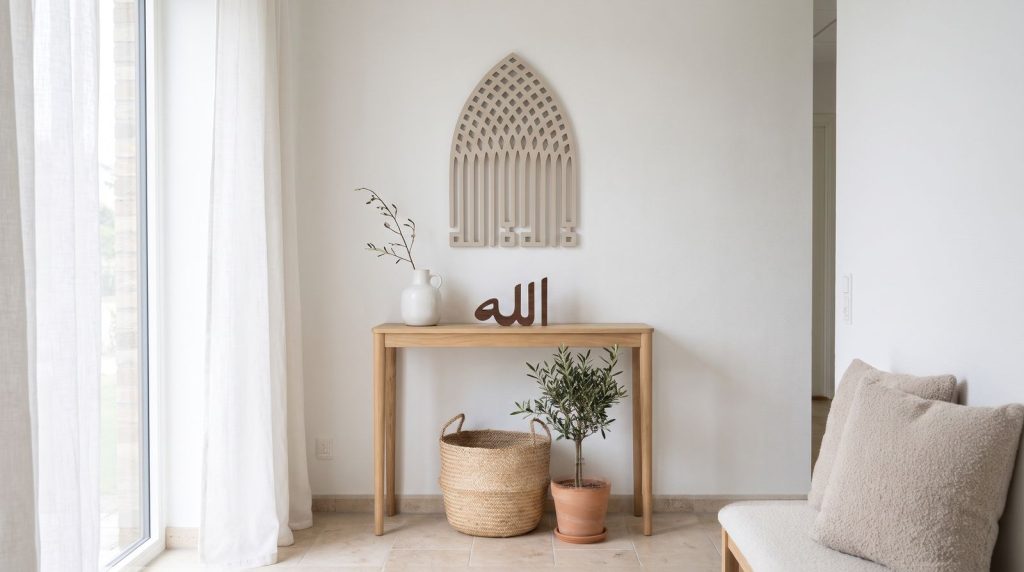
Which color should you choose?
| Color | On which wall? | Effect |
|---|---|---|
| Black | White, beige, linen | Graphically, contrasting, very readable |
| Brown | White broken, light terracotta | Warm, close to the forest |
| Beige | Dark wall, green, blue, polished concrete | Discreet, bright, elegant |
One tip: also look at the light. A black calligraphy against a window loses its clarity; a beige one on a white wall disappears. The contrast must be seen from the sofa.
Why choose wood over plexiglass or stickers
The vinyl sticker peels off, leaves marks and doesn’t move. The gilded plexiglass scratches and quickly takes on an inexpensive look. A calligraphy carved in wood has real presence, a thickness, an shadow cast on the wall that gives it relief. It peels off, cleans itself, and lasts for years. For such an important text, that counts.
What to put around it?
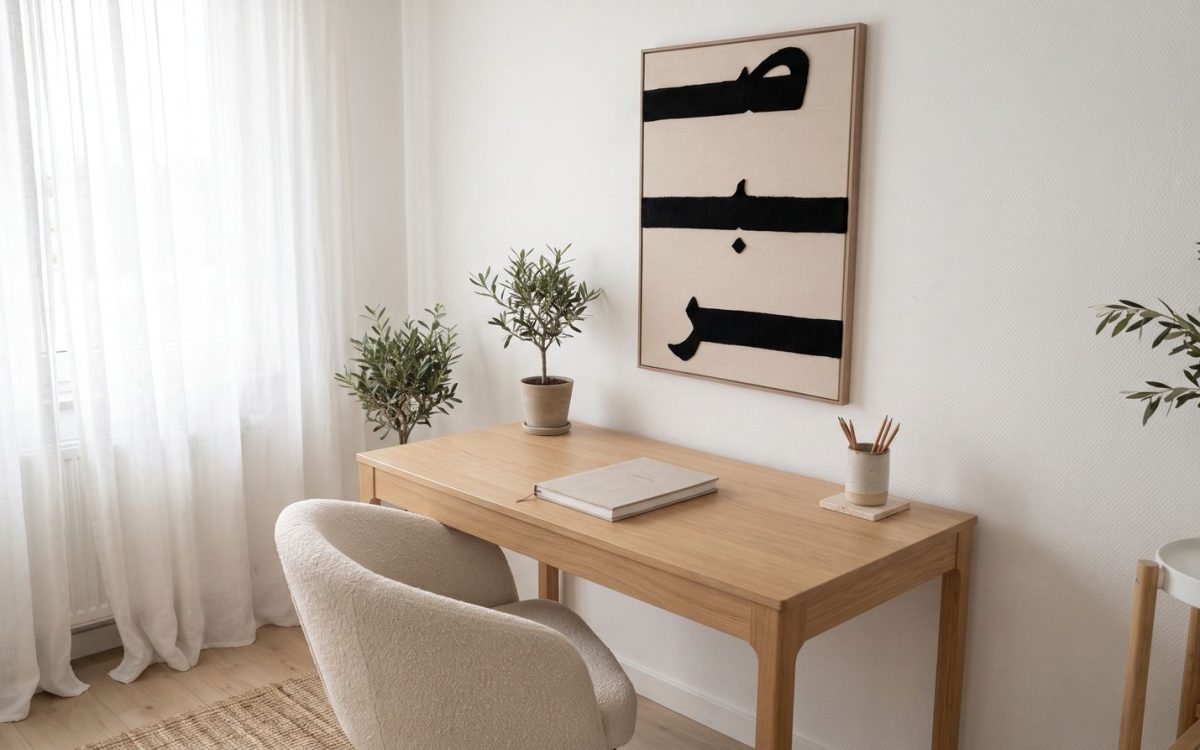
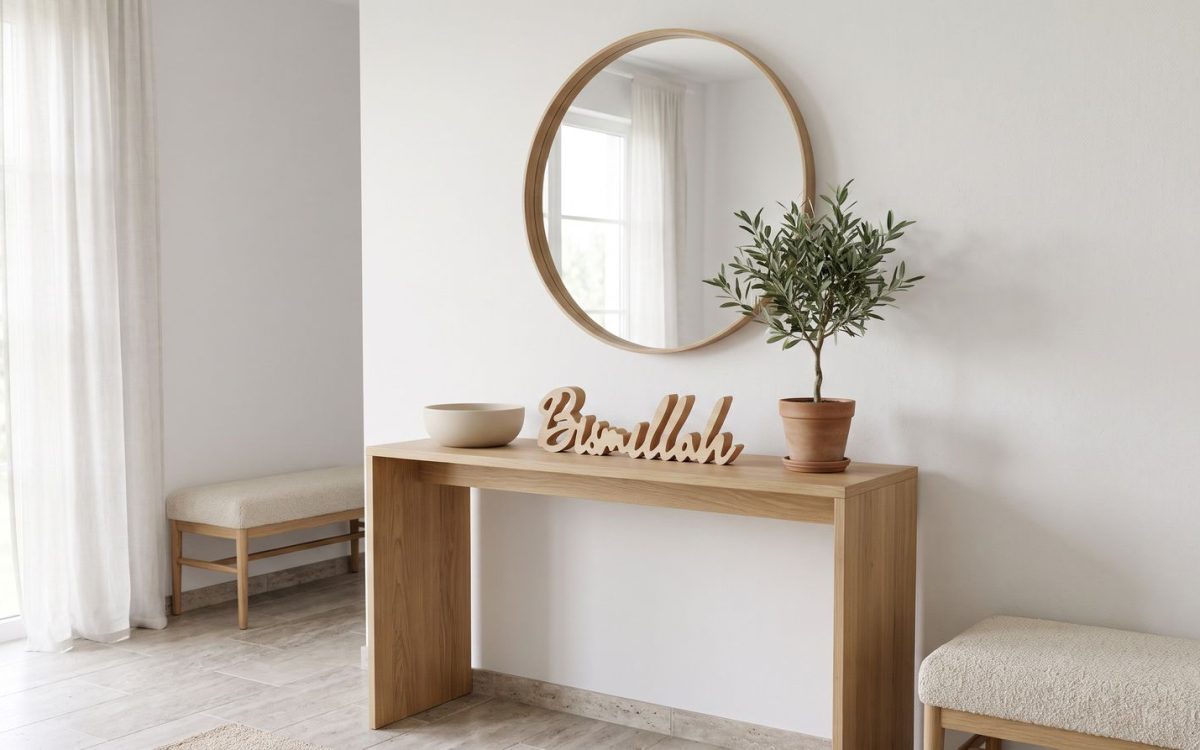
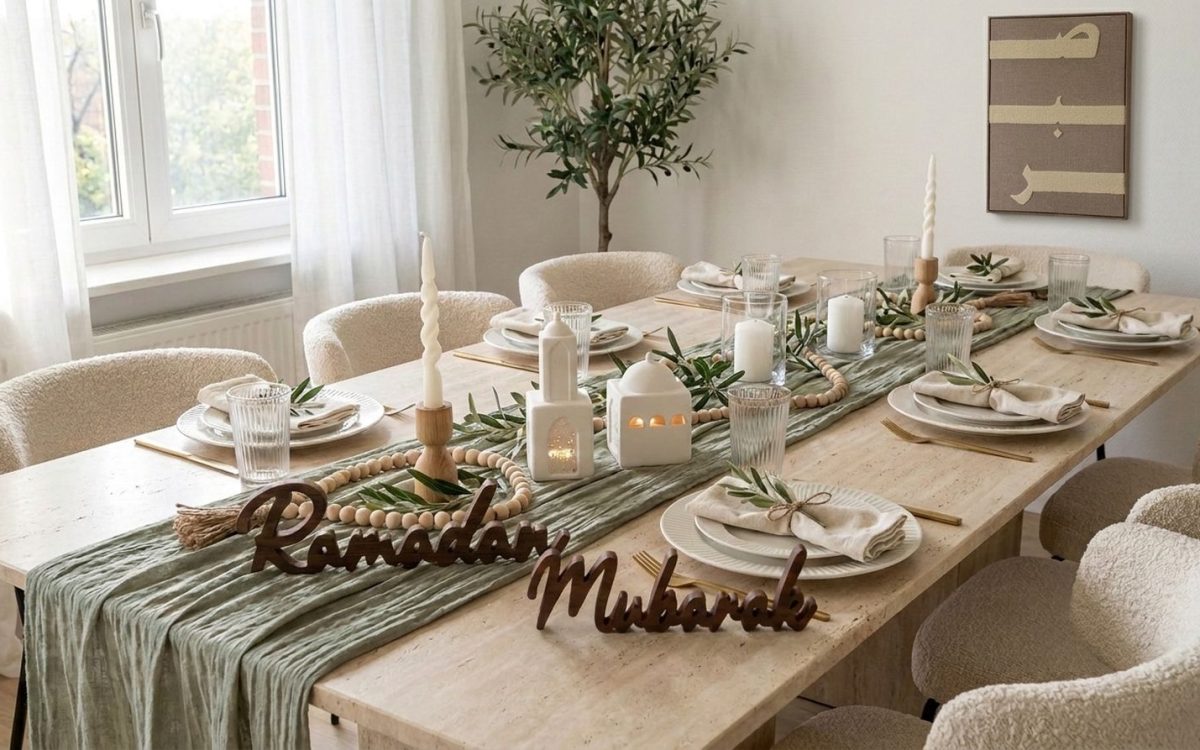
As little as possible. A calligraphy of the shahada doesn’t need photo frames around it. A plant, a lamp, a wooden console underneath suffice. If you want to complete it, a small note placed on the console (Bismillah, Alhamdulillah) or a Sabr painting in another room keep the whole look cohesive. Our ideas for creating a simple interior are in our article on modern Muslim decor.
A meaningful gift
The calligraphy of the shahada is also a very beautiful gift for a wedding, a first home, or someone who has just declared their shahada. In the latter case, it is a keepsake for a lifetime. More ideas in Our selection of Muslim gifts.
 Français
 Deutsch
 Nederlands
 English