
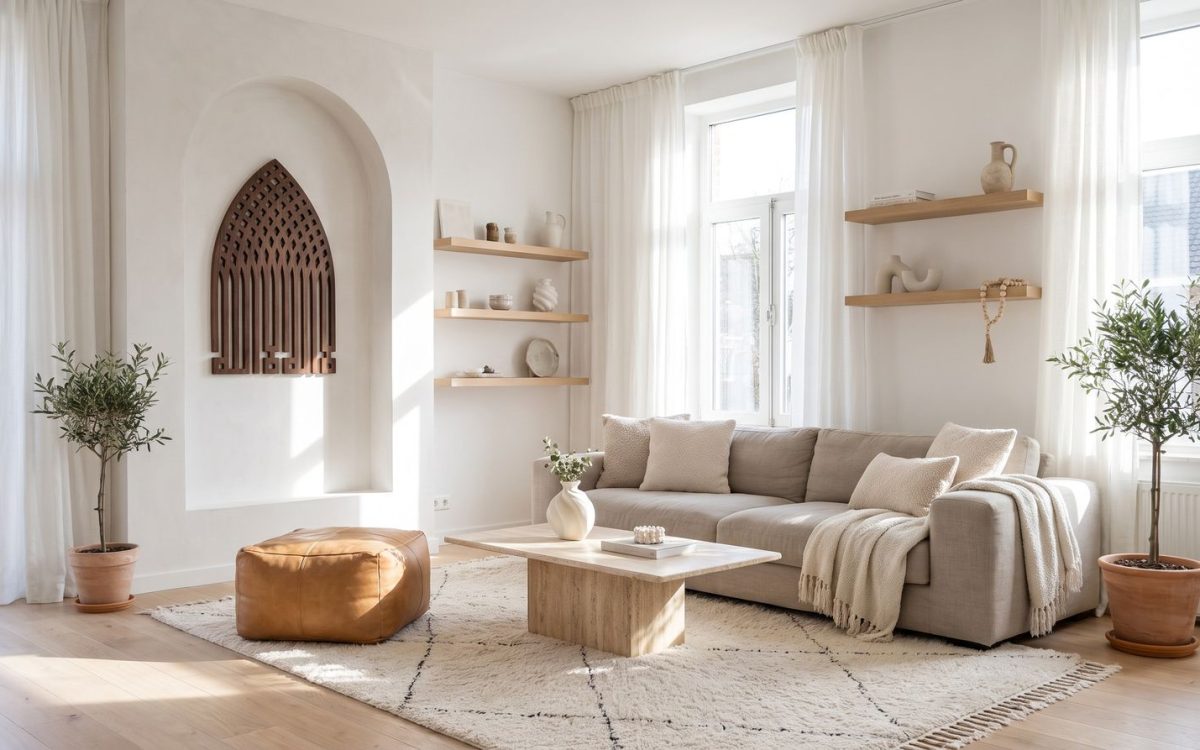
At our parents’ house, there was the Moroccan living room. The benches along the walls, the embroidered cushions, the wooden table with carved tops, the tea set always ready. A room that we sometimes only used for guests and special occasions. We, on the other hand, lived in 60 square meter apartments in Lyon, Brussels, Rotterdam or Düsseldorf, with an open kitchen and an angle sofa. And yet, we still want to keep something from there.
The good news is that the soul of a countryside home isn’t about the quantity of furniture. It’s about a few materials, a few shapes, a few gestures. Here’s how to bring them into a modern interior without turning your living room into a restaurant decor.
Moroccan, Oriental, Maghrebi decor: what are we talking about?
The Moroccan decor It draws on the craftsmanship of Morocco: zellige, tadelakt, cedar and thuya wood, leather, dinerie, Berber carpets. Oriental decor is a broader term that encompasses the Maghreb, the Middle East and Turkey: arches, moucharabiehs, lanterns, geometric patterns. In the diaspora, we often mix the two with our Algerian, Tunisian or Moroccan roots, and that’s very fine that way.
The common point is a special relationship with the home. The Quran speaks of the home as a place of rest:
And Allah has made a place of refuge for you in your houses.
«And Allah has made your houses a place of rest for you.»
Quran, Surah An-Nahl (16), verse 80 · translation of the meaning
The Arabic word, sakan (Housing), has the same root as sakina, Serenity. A successful home, at its core, is one where one finds that peace.
1. Start from a simple base
Light walls, neutral floors, furniture with simple lines: this is the background. On this basis, three or four Moroccan or Oriental pieces stand out much more than in the middle of a cluttered decor. This is the principle of the whole Modern Muslim decor : few items, but they count.
2. A Berber carpet, the piece that changes everything
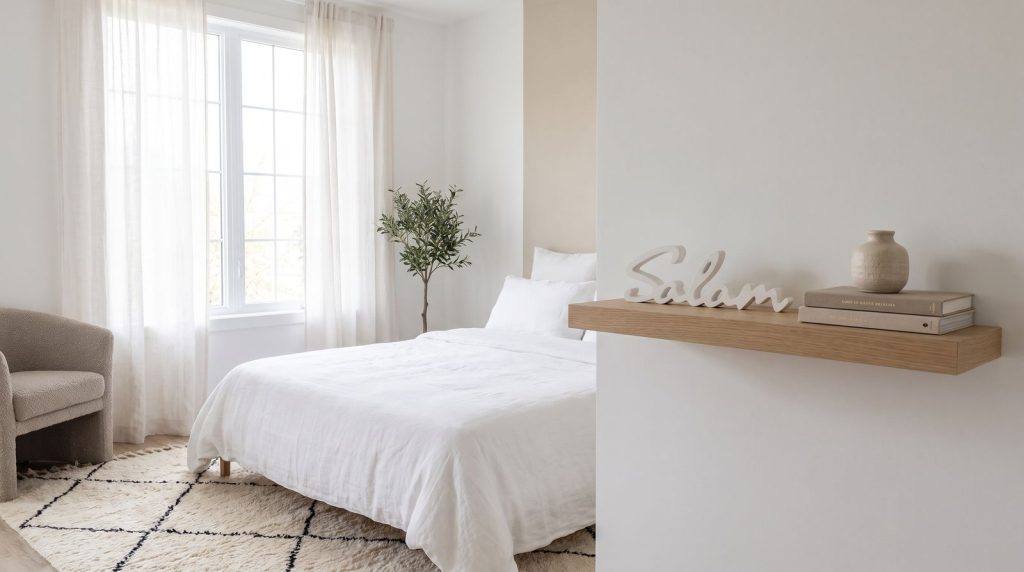
A Beni Ouarain in charcoal with black lines, a colorful Azilal, a woven kilim: the Berber carpet warms up any room. There is also the boucherouite, It is woven from scraps of fabric and old clothes. It is recycled carpet made in time, born from the ingenuity of women from the countryside. If you are looking for sustainable decor, there is no better option.
3. Wood, for the warmth
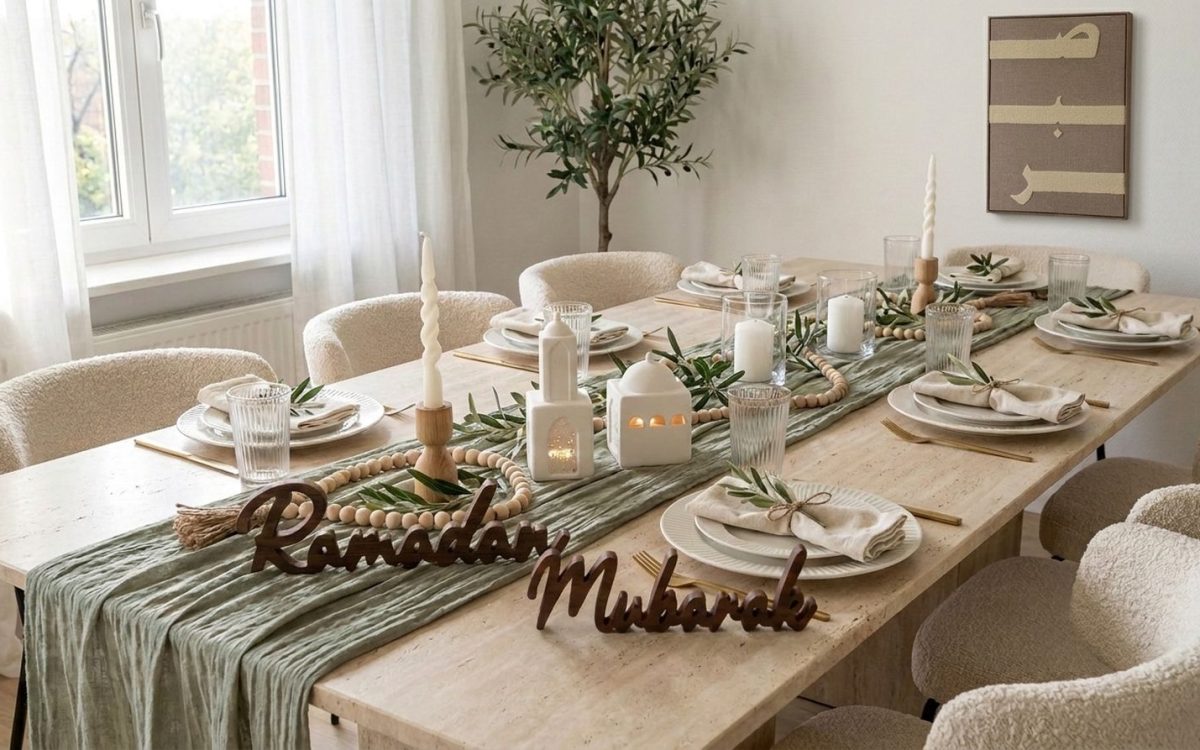
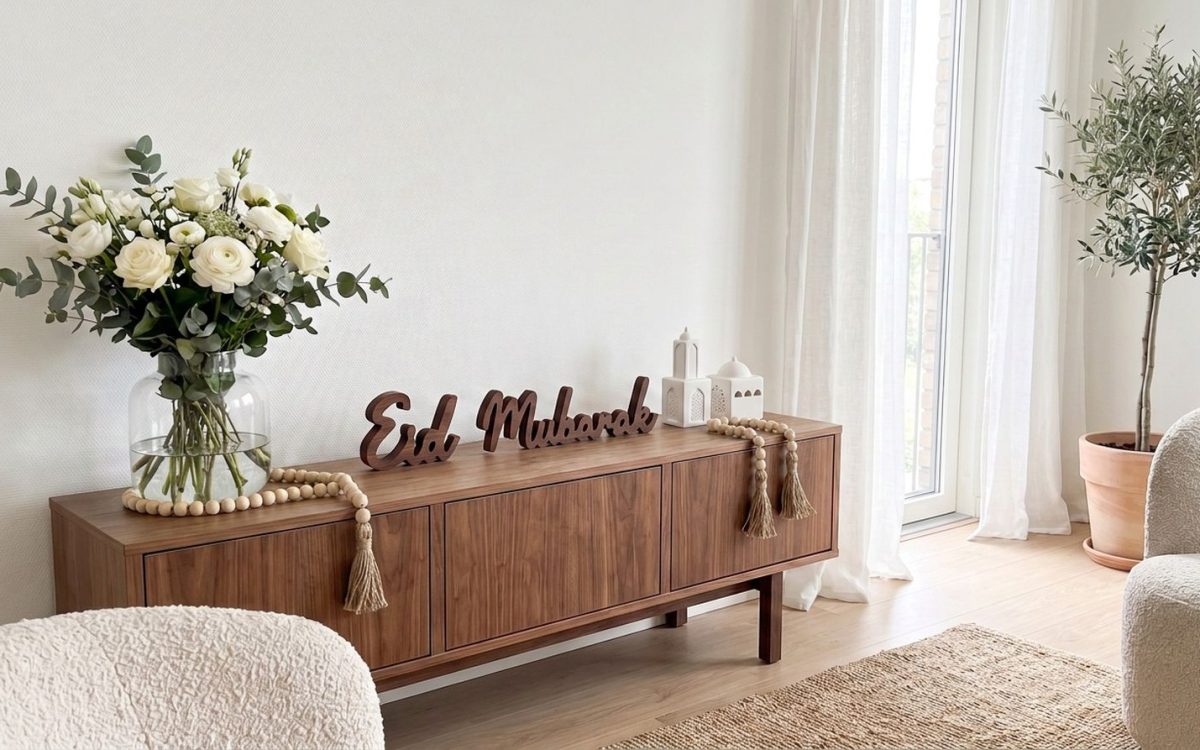
Atlas cedar, Essaouira thuja, olive tree: wood is used in every aspect of Moroccan craftsmanship, from carved doors to jewelry boxes. A tray, a coffee table, a wooden word on the wall are all enough to bring that warmth. Wood also has a rare quality: it ages well, unlike plastic and gilded finishes that mimic the old look.
4. The arch and the niche, the architecture of the homeland
The arch has made a comeback in decor everywhere, from mirrors to bed headboards. In our home, it has a special meaning: it is the shape of the doors of the medinas and the mihrab (Altar), the niche indicating the direction of Mecca in mosques. The word appears already in the Quran about Maryam, where it refers to her place of worship: «Whenever Zakariyya entered her presence in the mihrab, he found food near her» (surah Al Imran, 3, verse 37). The niche of mosques took that name later on.
A calligraphy in the shape of a mihrab on a white wall recreates this architecture without any work. It can also mark a prayer area (we explain how in our guide to the Salat district).
5. Copper and metalwork, used sparingly
A hammered copper plate, a silver-plated metal teapot, a latticed lantern. One or two pieces are enough. Beyond that, you quickly end up in the tea room decor. Choose real artisan pieces, even if you have fewer of them: they are passed on.
6. The filtered light
In the riads, the light arrives filtered through the moucharabies, cut into patterns on the walls. At home, a photophore or a lantern placed on the floor recreates this effect in the evening. This is also what we seek during the evenings of Ramadan.
7. Scent, the strongest memory
For many of us, the countryside is first and foremost a smell: orange blossom, incense, musk, fresh mint. Fragrancing the house was a daily task for our mothers and grandmothers. A diffuser in the entrance is enough to bring back those memories every time we walk through the door.
8. The tea corner, a ritual before it is decor
A tray, a teapot, colorful glasses, permanently placed on the coffee table or a low cabinet. It’s a decorative object, but above all an invitation: in our house, we don’t let a guest leave without a cup of tea. The most appropriate oriental decor is the one that serves.
Buy real craftsmanship rather than bazaar trinkets
Many items sold as «Moroccan» or «Oriental» are made in series, in resin or plastic, far from any craftsmanship. Before buying, look at the material, the finishes, and the origin. A real artisan object costs a little more, but it lasts for generations.
«Allah loves it when one of you performs a task with excellence.»
Hadith reported by al-Bayhaqi in Shu’ab al-Iman (4929), judged good (hasan) by al-Albani (Sahih al-Jami’, 1880)
This requirement of’itqan (Mastery), well-done work is exactly what we look for in an object we’re going to keep.
Keeping the soul of the homeland and passing it on to the children
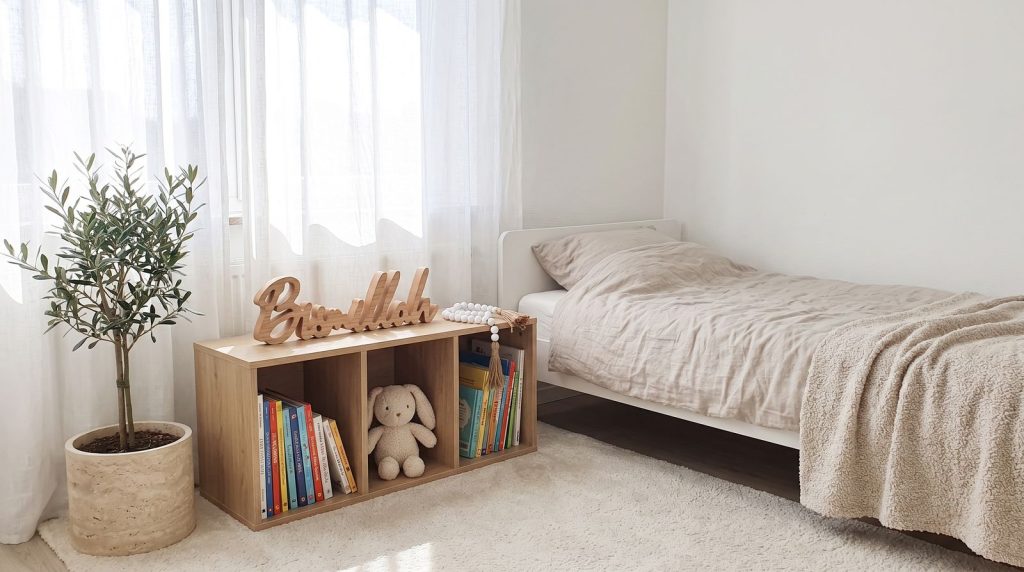
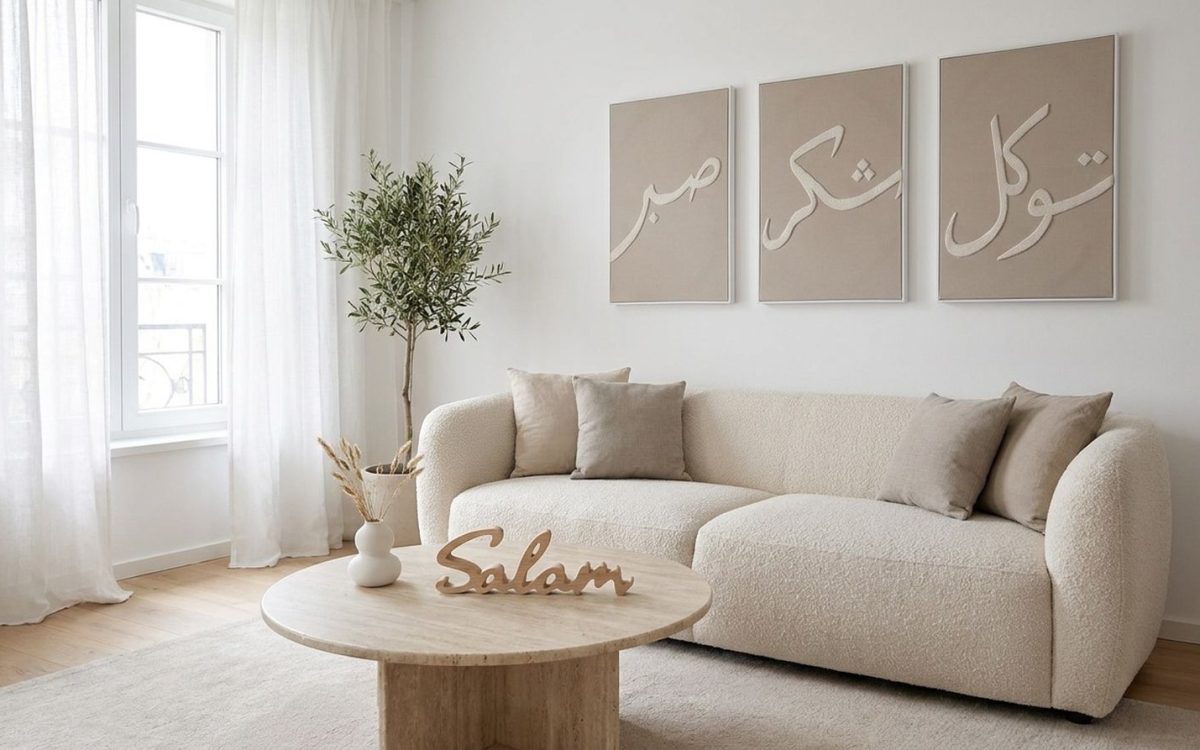
Our children grow up here. They will go to the countryside in the summer, perhaps less often than we do. The objects of the house—a grandmother’s rug, a plate brought back from a trip, an Arabic word on the wall—are all threads that connect them to their history. A successful Moroccan or Oriental decor is not a showcase: it is a home where one feels at home.
 Français
 Deutsch
 Nederlands
 English